
|
 |
Himayalan Slopes and Learning Curves
By Gareth Preece
The plan was simple. There were just the two of
us. Both of us had climbed in Europe and trekked in the Himalaya before.
We had done a lot of research, made contact with an in-country agent,
bought and acquired new shiny kit, dug out old kit and shoved it all
in bags. Once we had arrived in Kathmandu all we had to do was get to
Lukla, bimble up Mera Peak, down the remote Hingu Valley, over the high,
and relatively difficult, pass that leads down to Chukkung, the Amphu
Lapste and on up to Island Peak. We could be back down in Namche within
a month and home in time for Christmas. Light and fast, light and fast.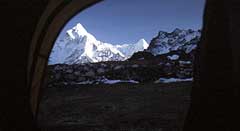
We bounced down in Kathmandu around midday, and found
and checked into a hotel. We then had a mooch around Thamel, 'orientating'
ourselves, usually several times, and never once in the right direction.
We spent some time investigating the options for our expedition. We
had particular requirements, in that we only needed Porters for part
of the way. We were doing this light and fast, we did not want to be
hindered by a full cook team and porter entourage.
After much discussion, with a variety of agencies,
it became clear that a ‘small’ team was going to consist of
7-10 porters, 2 kitchen boys, a cook, a guide and a Sirdar. The cost
of this took the original plan out of our budget instantly. We looked
around. We had been in Nepal for 12 hours and our plans had changed
dramatically already. We spotted a poster advertising expeditions going
to Lobouche East (6,119m) and Island peak (6,189m). We signed up. Each
peak would take 6 days, and we would meet the expedition out there,
giving us chance to acclimatise prior to the summit attempts.
That night we organised our kit to try to get it
somewhere close to the 20kg allowance for the flight into the mountains.
The following day we flew out to Lukla (2,800m) and after fending off
the over eager porter-guides, we headed to Phakding (2,652m), where
we stayed the night. The following day we set off for Namche Bazaar
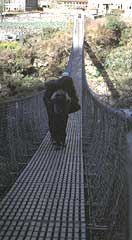
(3,445m). We were anything but light and fast. We were carrying 22kg
each and feeling the effects of altitude. We made it to Namche and rapidly
realised that there was no way we were ever going to be ‘light’,
or ‘fast’.
We spent a couple of days acclimatising in
Namche, and searching for a Porter. We were never going to be fast,
but with a Porter, we might actually make it further than Namche. Dowa,
our porter, carried an equal load, each of us carrying 15-17kg.
We made our way up to Gokyo, where we spent a further day acclimatising
by watching the ducks, eating cake and trekking up to the Fifth Lake,
where we had our first view of Everest. From Gokyo we crossed the Ngozumpa
Glacier and on to the Cho La (5,420m), where we got our first sight
of Lobouche East, “there had better be an easier side” was
the general feeling.
The Cho La consists of a steep and sustained scramble
over loose rock and ice sheets, before staggering out onto the glacier,
and into the sunshine. It was spectacular, both the view, and the feeling
as at this point, this was the highest I had ever climbed. We dropped
down into Dzongla, where stayed for a few days until we met the expedition.
We had signed up to what was described as a ‘climbing
course’ and so the first couple of days involved some training.
Several other members of the expedition had never climbed a mountain
before, and so to ensure that they knew their axe from their elbow we
headed back up to the Cho La and spent a day climbing the head wall
of the glacier.
From Dzongla we went up to Lobouche Base Camp,
just 30 minutes from the snow line, at 5,200m. We relaxed during the
afternoon, preparing ourselves for an early start. We set off at 2am,
snaking our way up the snow and ice by moonlight. By the time we reached
the Col the sun was coming up, and lit up the clouds with a dark orange
glow, casting shadows of the mountains onto them.
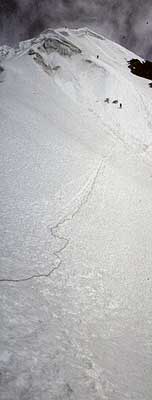
About an hour above the Col the ground steepened
and we clipped on to fixed ropes. I had been struggling with fatigue
at the Col, but now the sun was up and I was on the ropes, I found a
new reserve of energy. I made good progress; concentrating hard each
time I swapped ropes, tugging them twice to inform the next climber
that the rope was free.
We gathered on the summit for photos, looking out
over the Kumbu Glacier; Kala Pattar looking like a muddy lump far below
us. After around 40 minutes we started to make our way down from my
first 6,000m peak. We moved well on the way down, roped up over the
exposed sections, enjoying the sunshine, with a sense of smug satisfaction.
We arrived back at base camp at 2pm. 12 hours after setting off.
We spent that afternoon relaxing, eating and sleeping,
and headed out from the Base Camp the following day, with all the expedition
members going their own ways. Nick and I made for Dingbouche (4,300m)
for a rest day, and to wash some clothes. We arrived at the lodge and
sat outside in the warm sunshine, drinking hot lemon.
There is a feeling of smugness and satisfaction
you get from having been out and done something. I feel this way walking
into a pub after a day on the hill in the Lakes, knowing that I have
earnt the pint I am about to have. The feeling here was so much greater.
We spent the following day washing very smelly clothes,
chasing Yaks away from the lodge and retrieving our socks from the jaws
of a small Tibetan puppy.
Heading back up to altitude after our rest was
easier this time. We made our way up to Chukkung (4,700m), where we
would meet our guide again. This time we were the only two on the summit
attempt, and we did not need to do the training days. That day we walked
up Chukkung Ri (5,546m) and camped by a small lodge that night, eating
mo mos, potato pancakes and drinking black tea.
In the morning we got up and made our way to Island
Peak Base Camp (5,100m). The trail followed a glacier and then lead
into a vast flat valley, where the wind gently whipped the sand into
your eyes and up your nose. We crossed some boulders and set up the
tents at the foot of the mountain.
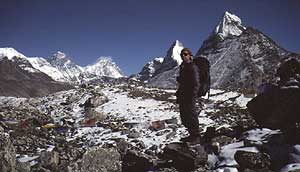
Island Peak stands clear of the surrounding mountains,
with the Lhotse Massif, and it’s clear and impressive rock strata,
towering above. It is truly an Island of rock, and I was apprehensive,
but excited, to be given the opportunity to attempt to climb it.
The wind was evidently picking up into the evening,
and by 1am, when we got up to head for the summit the combination of
the altitude and cold slowed the preparation to a crawl. Following a
bowl of muesli, with hot powdered milk, and black tea, we set off up
the loose rocky slopes at 2am, passing High Camp an hour later. In the
distance we could see torch light. After three hours of walking we caught
up with a trio of lost Italian climbers, and we found some common ground
in the French language and explained the route to them.
I felt dreadful. I had a pain in my stomach, was
breathless and very slow. I could only walk short distances before having
to stop and rest. After what seemed like a few days, we reached the
snow line. As we sat to put our crampons on, and take our axes off our
sacks the Italians appeared from behind the rocks.
We roped up and set off in a single line, leaving
the Italians behind. We crossed a narrow ridge and headed for safer
ground. We stopped, and I allowed the muesli, which had clearly not
wanted to be in my stomach to escape onto the snow. I felt instantly
better.
We carried on across the snow, with the sun rising
and lighting up the ground and the mountains around us. We reached the
steep snow slope that lead up to the summit ridge in daylight. I opted
to go first, and ascended the fixed rope to the ridge. Reaching the
ridge, the full force of the wind hit me. Having warmed up on the climb,
the small areas of skin on my face that were exposed cooled rapidly
as I waited for Nick to follow.
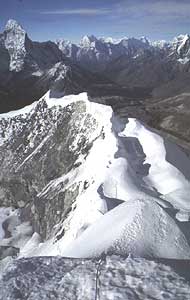
We both sat on the ridge waiting for the ropes
to be fixed for the climb to the summit. Nick decided he would not continue,
so I took his jummar and followed the fixed line, as it snaked over
the ridge and up to the summit.
Walking along the ridge, the wind would gust with
such force that it would nearly blow me off my crampons. I staggered
to each new section of rope, climbing, with great joy, when in the lee
of the wind, and gritting my teeth and plodding on when I was feeling
it’s full force.
I could see Nick curled up, sheltering from the
wind, on the ridge below, looking out across the Himalaya as I climbed.
And then I ran out of rope, the ground flattened and Tenzing’s
grin was all I could see. I unclipped from the rope, he took my gloved
hand and we walked to the summit together. We hugged and congratulated
each other, prayer flags fluttering at our feet as we looked across
the sea of mountains from this island.
We were back at Base Camp within 10 hours, and
spent the night relaxed in satisfied slumber. The Porters and guide,
however, had a less than comfortable night’s sleep, with the cook
tent blowing over three times in the 60mph winds.
We practically ran down to Dingbouche,
in the warmer, thicker air. We stayed one night there and had the most
revolting meal of Spam Pizzas. The following morning we hired another
porter and began the walk back to Lukla, through the forests to Namche
Bazaar and on. 4 days later we were sitting in Lukla, waiting for aeroplanes
to take us back to Kathmandu, dinking our first beer for over a month.
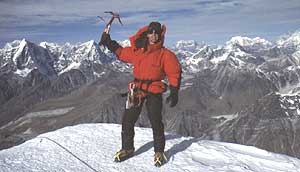
Climbing mountains has a magic that cannot be explained,
but Himalayan climbing is something else. The magnitude of the landscape
cannot be comprehended until you see it, and the realisation of the
logistics involved in climbing relatively straightforward peaks humbles
even the most adventurous climber. I came to understand that, when it
came to climbing Himalaya, I would never be ‘light’ or ‘fast’.
Written by Gareth Preece, all text and images copyright
Gareth Preece.
Gareth is the owner of Rock Steady outdoor learning centre
|
|
|
|


